

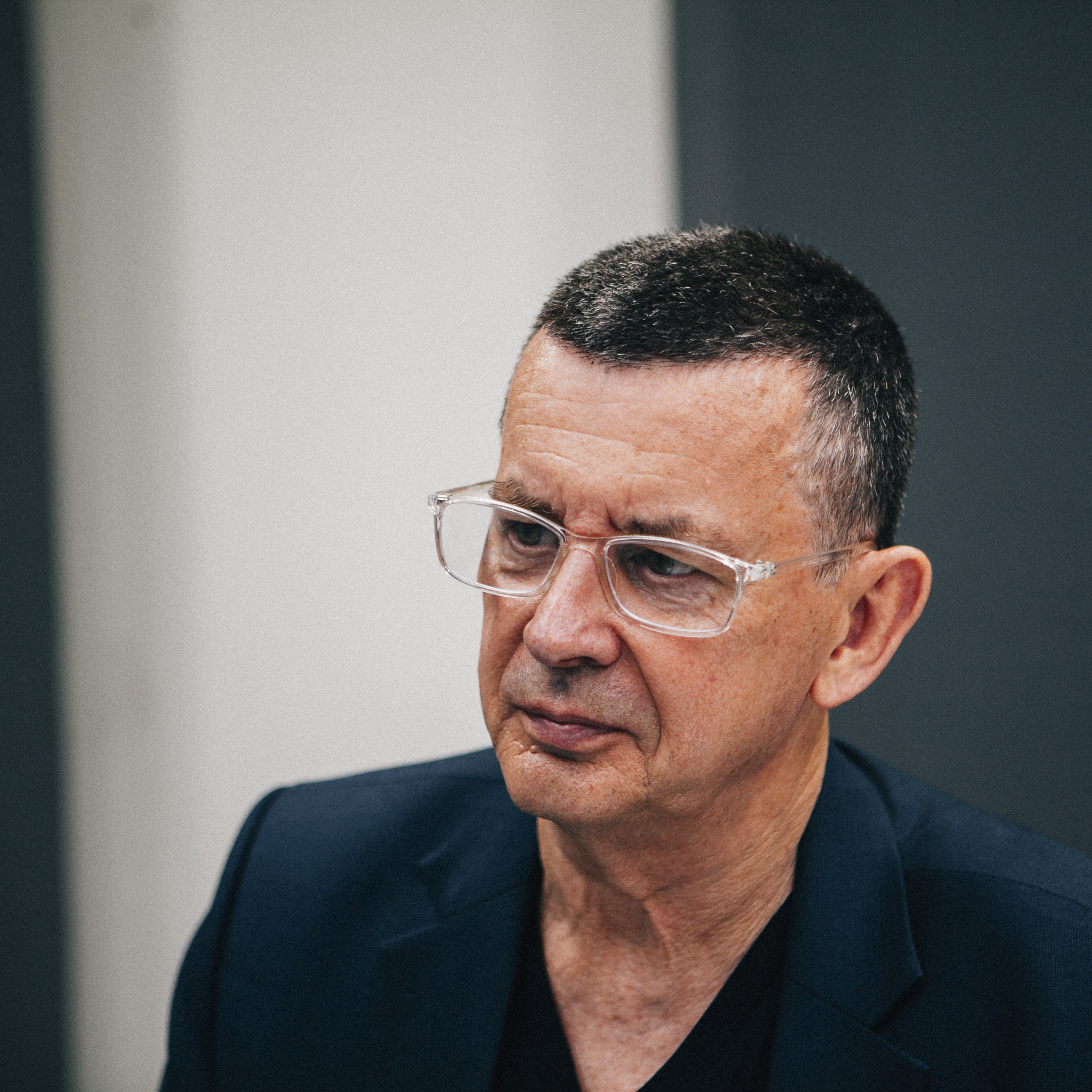
Welcome to the 100th episode of the Design Education Talks podcast by The New Art School, a momentous milestone in our journey of exploring design, creativity, and education with some of the world’s most inspiring voices. For this landmark edition, we welcomed back our very first guest: the brilliant and unapologetically authentic Professor Phil Cleaver.
Phil’s return is not just a nostalgic nod; it’s a full-circle celebration of a life richly lived through design. His journey, from a cheeky East End kid with a rebellious streak to a globally respected designer and educator, is as illuminating today as it was when he first joined us in episode one. This conversation dives deeper into the roots of creativity, the evolution of design practice, and what design education should, and shouldn’t, be today.
From Kitchen Table to Global Stage
Phil’s story begins at age 15, quite literally around the kitchen table. With his mother acknowledging his knack for getting into trouble and his talents in cooking and art, it was clear that creativity was in his bones. But cooking was out, he didn’t speak French, and in those days, you needed to. Art was in. With typical East End bluntness, his parents laid out the stakes, and his mother delivered the now-legendary line: “You could throw that little bastard in the sewer and he’d come out smelling of roses.”
That odd but heartfelt endorsement propelled Phil into Harrow and later the Central School of Art and Design, where he found his calling, and his lifelong mentors.
The Power of Mentorship and a Good Fight
Phil credits much of his early development to typographer Anthony Froshaug at Central. Their relationship began with friction and fire: Froshaug criticized a layout, Phil fired back with a defiant “Bollocks!”, and then went off to typeset Gill Sans by hand for a month. His comeback? “Now tell me that ain’t readable.” That moment forged mutual respect and kicked off a meaningful mentorship that opened doors, including one to Alan Fletcher at Pentagram.
What followed was a masterclass in 20th-century design: working with Wim Crouwel at Total Design in the Netherlands, absorbing branding brilliance at Wolff Olins, leading creative direction at Allied International Designers, and finally, building his own studio, Cleveland, and later Et Al (Etow).
Beyond the Brief: A Philosophy Rooted in Thinking
Phil’s approach was shaped by Central’s pedagogical refusal to churn out cookie-cutter designers. “They didn’t want mini graphic designers,” he explains. “They wanted thinkers.” He was trained to design anything, not just visual identities, but ideas. Exhibition design, branding, signage, each project was approached with conceptual clarity, often outside his comfort zone.
And in the pre-digital days, this approach was grounded in exploration. Instead of Googling “dog,” Phil would leaf through Picasso, Chagall, or dusty art history books. “Computers make life easier, but not better,” he says. “AI is artificial. Creativity is human.”
Rebellion as Pedagogy
In a design school culture fixated on finishing projects, Phil rebelled. He spent months setting type while others scrambled for final show materials. He describes this hands-on immersion not just as technical training, but as a mindset shift. “It was about thinking through making.”
This philosophy continues to shape how he teaches. Rather than adhering to structured projects, Phil draws from students’ lives. Love noodles? Photograph yourself throwing them. Into fashion? Make a lettuce dress. The message: ideas start in your life, not your screen.
On Getting In: Lessons in Grit
One of the most gripping parts of our chat involved Phil’s no-holds-barred entry into the industry. Back in the analogue days, he couldn’t rely on a LinkedIn profile or Behance page. He once sent a studio an invoice after showing them his portfolio, just for entertaining them. They didn’t pay, but they remembered. His name began to circulate in London’s design circles not because of conformity, but because of creativity, audacity, and charm.
This flair for unconventional thinking is what he believes young designers need today. “Cold emailing your portfolio isn’t enough,” he says. “Do something memorable. Think like a designer from the first point of contact.”
From Blandism to Boldness: Design’s Evolution
When asked how the industry has changed, Phil doesn’t mince words: “There’s too much blandism.” For years, he watched as brands adopted the same stripped-back type-and-colour schemes in a quest for minimalism that morphed into sameness. But the pendulum is swinging back. Now, brands like Burberry are yearning for uniqueness.
The future, he argues, belongs to those who push back against homogenization and create identities grounded in storytelling and symbolism. “Ideas sell,” he insists. “Designers need to show up, meet the client, read body language. Otherwise, you’re designing with one arm tied behind your back.”
Design Education’s Biggest Problem? Screen Addiction
Phil is vocal about a pervasive issue: screen dependence in design education. “Students are living on screens, not in life,” he says. Too many graduates leave school as “Mac monkeys”, technically proficient, but creatively underdeveloped.
His remedy? Ban computers temporarily. Force students to explore the real world. Sketch, take photos, make things. At Middlesex, he ensures students have access to everything from silkscreen and letterpress to 3D modelling and riso printing. “Physicality drives creativity,” he says. “You understand more when you touch and make.”
Internships: A Two-Way Investment
Phil has created an internship culture where value goes both ways. At Etow, students train for a year with one-to-one mentorship. It’s not about making coffee, it’s about honing skill. Sixteen students have left with top degrees in the past 17 years. His advice: find studios where you learn, even if you’re not paid much. “It’s about the work, not the money, at first.”
On Clients, Courage, and the Joy of Play
Whether rebranding an Asian bank or designing a logo for a rat catcher, Phil’s secret is the same: courage and clarity. His trick? Answer the brief, then go ten miles further. “Clients always buy the bold version,” he says. “But you’ve got to show, not tell.”
Phil’s client presentations lean visual and visceral. For the Burton’s rebrand, his benchmarked bulldog, Montague in sunglasses, ticked all the boxes: tradition, humour, and British edge. “Visual benchmarks guide clients better than endless chatter,” he explains.
The Wisdom of a Hundred Conversations
As our chat wound down, Phil offered a final reflection for the next generation:
“Be yourself. Ignore half the advice. And most importantly, have fun. Loving what you do is what gets you through.”
With that, the episode closes, not just a podcast, but a time capsule of one designer’s refusal to conform, his devotion to the craft, and his call to every emerging designer to step away from the screen, step into the world, and think differently.
Thank you, Professor Phil Cleaver, for being with us again. We look forward to episodes 200 and 300 with you just as much. Here’s to more creativity, more courage, and more conversations that matter.
Episode 1
https://www.buzzsprout.com/1969986/episodes/10431566
and here: https://odysee.com/@thenewartschool:c/design-education-talks-ep-1-phil-cleaver:f
Episode 100
https://www.buzzsprout.com/1969986/episodes/16751275
and here: https://odysee.com/@thenewartschool:c/100:d35
Where to Find More
For those interested in exploring more of Phil Cleaver’s work, his design projects can be found at etal-design.com, and his book art at philcleaver.com
Since its inception in 2019, Design Education Talks podcast has served as a dynamic platform for the exchange of insights and ideas within the realm of art and design education. This initiative sprang from a culmination of nearly a decade of extensive research conducted by Lefteris Heretakis. His rich background, intertwining academia, industry, and student engagement, laid the foundation for a podcast that goes beyond the conventional boundaries of educational discourse. Support the Show 👉https://www.patreon.com/thenewartschool Equipment used to produce the podcast: 👉https://kit.co/heretakis/podcasting See our work on 👉https://linktr.ee/thenewartschool Follow us on twitter at 👉@newartschool Read our latest articles at 👉https://heretakis.wordpress.com/ and 👉https://heretakis.medium.com/

 The New Art School