

The New Art School exists to protect and develop the human purpose of art and design education.
We are living through a profound change in creative practice. Artificial intelligence can now generate images, text, concepts and increasingly convincing creative outputs in seconds. This changes what creative education must do.
If the production of an output is no longer sufficient evidence of learning, then education must return its attention to something more fundamental: the development of the person who creates it.
The New Art School is committed to helping art and design education develop human judgement, creative agency, curiosity, cultural understanding, material intelligence and the capacity to think and act independently.
Education is more than the production of work
We believe the purpose of education is not simply to produce portfolios, qualifications or technically competent outcomes.
Education should transform the learner.
A student should leave an art or design school with a deeper ability to observe, question, research, make, judge, communicate and take responsibility for decisions.
The final artefact matters, but the development that takes place through making it matters more.
When technology can produce increasingly sophisticated outputs automatically, this distinction becomes essential.
The question is no longer simply, “What did the student produce?”
We must also ask: “What did the student understand, discover, experience and become capable of doing?”
Hand, heart and eye
The New Art School places the relationship between the hand, the heart and the eye at the centre of creative education.
The hand represents making, material experience, craft, repetition and physical engagement with the world.
The eye represents observation, visual judgement, attention and the ability to recognise difference, proportion, rhythm, structure and quality.
The heart represents intention, empathy, curiosity, emotional investment and the human reasons for making something in the first place.
These capacities should not be separated.
Making is not the opposite of thinking. Making is one of the ways human beings think.
Drawing, constructing, photographing, printing, modelling, writing, prototyping and working directly with materials allow students to encounter forms of knowledge that cannot always be reached through description or automation.
Digital technology can extend these capacities, but it should not replace the developmental experiences through which they are formed.
Studio culture matters
We believe strongly in the value of the studio.
A studio is not simply a room containing desks and computers. It is a social and intellectual environment.
Students learn by seeing work develop around them. They learn through conversations, disagreements, accidents, demonstrations, observation and informal exchange.
They encounter other approaches. They witness failure. They see ideas change.
This kind of learning is difficult to measure, but it is central to creative development.
The New Art School advocates for a renewed studio culture based on presence, participation, experimentation, peer learning and sustained engagement.
We believe creative education should provide students with meaningful time and space to work alongside one another, rather than reducing education to a sequence of submissions, online platforms and administrative transactions.
AI should support learning, not bypass it
Artificial intelligence is an extraordinary tool.
It can expand access, accelerate processes, open new possibilities and remove many technical barriers.
But educationally, the important question is not simply what AI can do.
The important question is when its use helps a student learn and when it allows the student to bypass the very experience through which learning would have occurred.
If a tool performs the difficult conceptual, visual or intellectual work before the learner has developed those capacities, efficiency can become educational loss.
The New Art School therefore supports the thoughtful and critical use of AI.
Students should understand these technologies, experiment with them and learn to work with them responsibly.
But technology should remain in service of human development.
AI should extend human capability rather than prematurely replace the experiences through which capability is formed.
Assessment must change
Generative technologies also challenge traditional approaches to assessment.
For many years, education has relied heavily on finished outputs as evidence of individual achievement.
That assumption is becoming increasingly fragile.
A polished image, text, presentation or design can no longer reliably demonstrate how much a student understands or how independently the work was developed.
Assessment must therefore pay greater attention to process.
Research, development, experimentation, critique, decision-making, iteration, reflection, conversation and the ability to explain and defend choices all become increasingly important.
The New Art School advocates forms of assessment that make learning visible.
This can include live critique, oral explanation, process documentation, observation of studio activity, iterative project development and direct discussion between students and educators.
Assessment should not become surveillance.
Its purpose should be to understand development, not to police students.
Human judgement is becoming more important, not less
As machines become more capable of generating possibilities, the ability to choose between those possibilities becomes more valuable.
Students need to develop judgement.
They need to recognise quality, relevance, originality, appropriateness and meaning.
They need to know when something is finished, when something is wrong and when an apparently convincing result lacks substance.
Judgement develops slowly.
It develops through exposure, history, practice, critique, comparison, failure and sustained engagement with a discipline.
This is why the foundations of art and design education remain essential.
History matters.
Visual culture matters.
Material understanding matters.
Drawing matters.
Conversation matters.
Criticism matters.
Making matters.
These are not nostalgic attachments to an older model of education. They are some of the ways in which human judgement is formed.
Creative agency
The New Art School is committed to developing students who can act rather than simply respond.
Creative agency means being able to identify problems, formulate questions, make decisions, initiate work and take responsibility for outcomes.
It means not becoming dependent on a particular piece of software, platform or technological system.
The creative industries will continue to change.
Specific tools and professional roles may disappear or be transformed.
Education therefore has to offer students something more durable than training for the software or workflow of the present moment.
Students should develop the confidence and intellectual independence to continue working when circumstances change.
The goal is not simply industry readiness.
It is capacity under changed conditions.
Analogue and digital belong together
The New Art School does not advocate a retreat from technology.
Nor do we believe digital tools should automatically replace analogue processes.
The strongest creative education allows students to move intelligently between both.
A pencil, camera, printing press, piece of software, generative model, notebook, physical prototype and digital interface are all tools.
Each allows different kinds of thinking.
Students should understand the qualities, limitations and consequences of the tools they choose.
The aim is not to preserve analogue practices as museum pieces.
It is to preserve the forms of attention, judgement and embodied knowledge that certain processes cultivate.
Technology should increase creative possibility without narrowing human capability.
Access without simplification
We believe powerful creative tools should become more accessible.
The removal of technical and financial barriers can allow far more people to participate in creative culture.
That is a positive development.
But access to tools is not the same as education.
Creative education provides context, history, standards, community, challenge, feedback and sustained development.
As access to production becomes easier, these things become more important rather than less.
The task of education is not to protect professional knowledge through unnecessary gatekeeping.
It is to help people develop the understanding required to use powerful tools intelligently and responsibly.
Learning through difficulty
Not every difficulty in education should be removed.
Some forms of difficulty are developmental.
Learning to draw, edit, observe, compose, write, construct, photograph or articulate an argument requires patience.
Failure and uncertainty are often essential parts of creative development.
The New Art School distinguishes between unnecessary barriers and productive difficulty.
Education should remove obstacles that prevent participation.
But it should not automatically remove the intellectual, creative and material challenges through which capability develops.
Convenience is not always the same as progress.
Critique as a form of care
Critique is central to creative education.
Good critique is not humiliation and it is not the performance of authority.
It is a serious conversation about work.
Students should learn how to present ideas, receive criticism, question assumptions and respond constructively.
Educators should create an environment in which disagreement is possible without becoming destructive.
Critique teaches students that creative work exists beyond personal preference.
It introduces standards, argument, evidence and responsibility.
In an age of automated feedback and algorithmic recommendation, direct human conversation remains especially valuable.
Education as becoming
Ultimately, The New Art School understands education as a process of becoming.
A student enters education with one way of seeing the world and should leave with another.
They should notice more.
They should ask better questions.
They should become more capable of making distinctions.
They should know more about the histories and cultures in which their practice exists.
They should become more confident in acting without instructions.
They should become capable of challenging both technologies and institutions rather than merely adapting to them.
This transformation cannot be reduced to a portfolio or learning outcome.
It is the deeper purpose of education.
Our commitment
The New Art School is committed to working with educators, institutions and students who want to rethink art and design education for the conditions now emerging.
Our work focuses on teaching, assessment, studio culture, creative agency, analogue and digital practice, AI, making, judgement and the preservation of meaningful human learning.
We believe the future of art and design education should not be built around competing with machines in the production of outputs.
It should be built around developing the human capacities that make creative work meaningful in the first place.
The New Art School helps art and design schools redesign teaching, assessment and studio culture for an age in which AI can produce the output, but cannot replace the human learning, judgement and creative agency that education exists to develop.
Evidence of our work
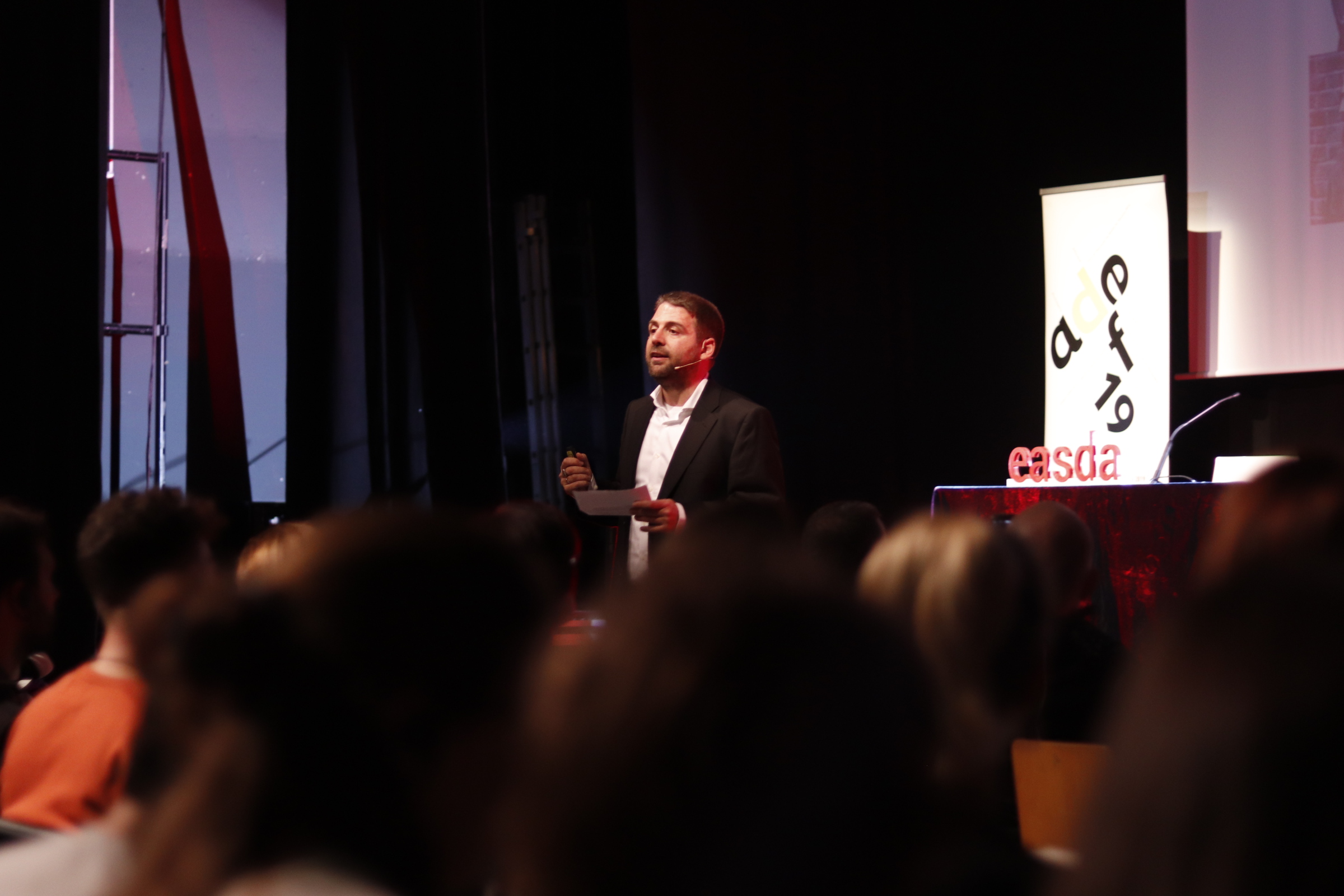
The commitments described here are reflected across The New Art School’s educational work, writing, workshops, lectures and international collaborations.
Our work includes research and writing on the future of art and design education, studio culture, creative agency, assessment in the age of AI, analogue and digital practice, hand–heart–eye coordination and the changing relationship between education and the creative industries.
Through workshops and educational programmes, including Unlock Your Design Superpower: How to Thrive in the Age of AI, we explore how students can develop independent creative judgement through research, making, experimentation, critique and reflection.
Through public writing, lectures, conversations and the wider Design Education Talks community, we continue to examine what art and design education should preserve, what it should change and what kinds of human capability will matter most in the decades ahead.
This page represents an ongoing public commitment to those principles.


You must be logged in to post a comment.