

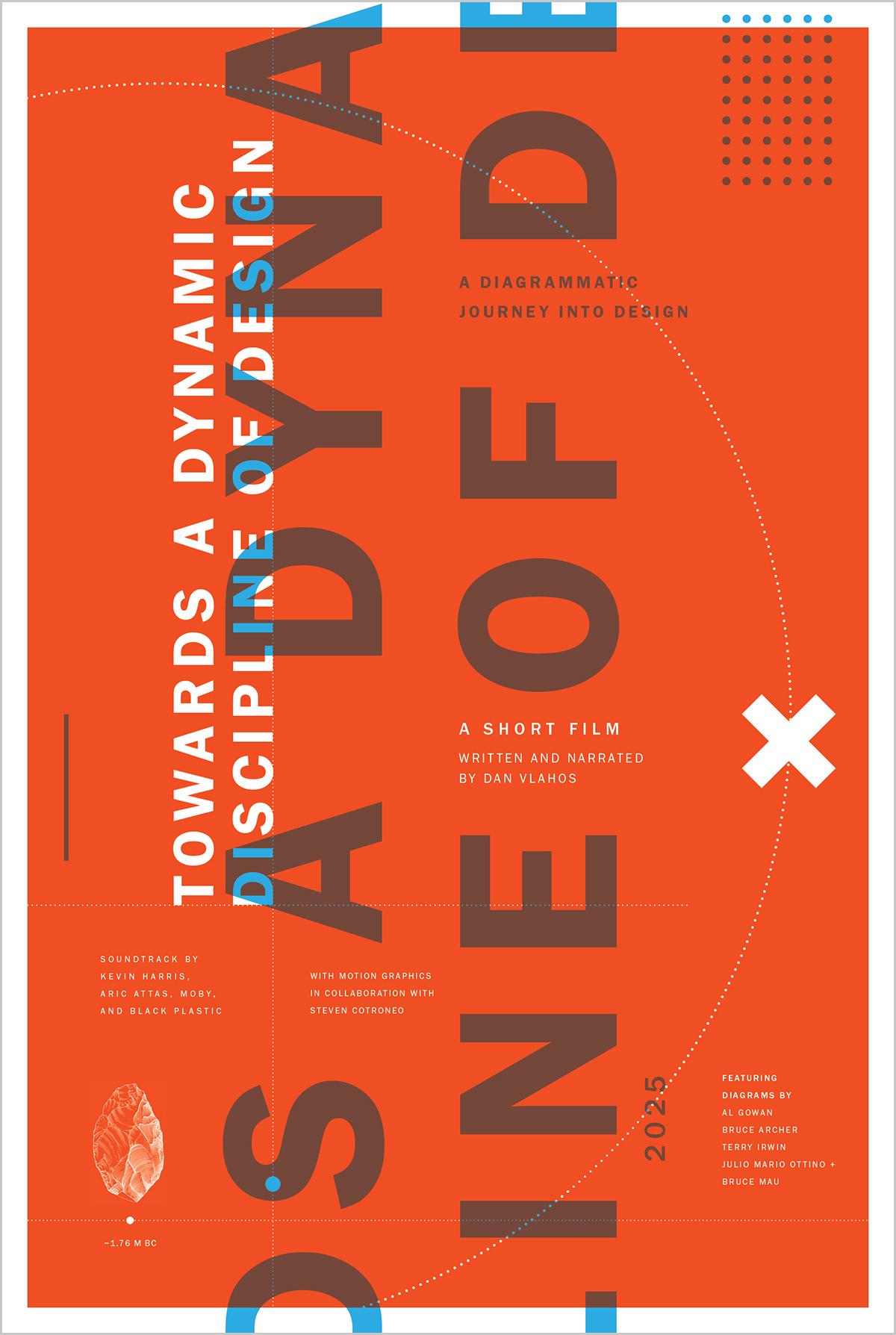
Inspired by content from Dan Vlahos, AIGA DLand Steven Cotroneo
Watch the film here:
Introduction: Redefining Design’s Place and Purpose
Design is a word that defies simple definition. It is both a noun and a verb, a process and a product, a practice that spans millennia yet remains elusive in its academic and cultural positioning. The short film Towards a Dynamic Discipline of Design embarks on an educational and diagrammatic journey to address two pivotal questions: Where does design belong in the 21st century? and Who does design belong to? Premiering at the 2025 MODE Summit in Prague, this film challenges static notions of design, advocating for its recognition as a dynamic, dialogic, and alterplinary discipline, a third epistemological culture alongside art and science (Vlahos, 2025a).
Through a blend of historical reflection, scholarly insight, and kinetic visualisations, the film traces design’s evolution from ancient tools to modern systems, urging viewers to rethink how design is visualised and practised. This article distils the film’s narrative, exploring its key themes and arguments, from the hand-axe of the Pleistocene to the multidisciplinary design teams of today.
A Historical Anchor: The Hand-Axe and Design’s Origins
The story begins over 1.76 million years ago in ancient Africa, with the hand-axe, a bifacial stone tool that represents one of humanity’s earliest design artefacts. These tools, discovered across Africa, the Middle East, and Europe, were not only functional for tasks like cutting and woodworking but also exhibited aesthetic qualities, suggesting early humans cared about symmetry and form (Wynn & Gowlett, 2018). This duality prompts a timeless question: Is design an art, a science, or something else entirely?
The hand-axe serves as a tangible reminder of design’s deep roots in human ingenuity, blending utility with creativity. It sets the stage for the film’s exploration of design as a discipline that transcends binary categorisations, a theme echoed throughout its narrative.
Design as a Third Culture: Gowan, Archer, and Beyond
The film draws heavily on the work of design scholars like Al Gowan and Bruce Archer, who grappled with design’s epistemological place. In 1969, Gowan, then editor of the short-lived journal Designcourse, proposed design as a bridge between art and science. His three-part diagram (art, design, science) suggested that design need not align exclusively with either field but could serve as a vital link (Gowan, 1969). A decade later, in 1979, Bruce Archer expanded on this idea in his paper “Design as a Discipline,” positing design as a third area of education alongside science and the humanities. His triangular diagram, with design as “modelling,” humanities as “language,” and science as “notation,” positioned design as an equal partner in knowledge production (Archer, 1979).
Archer’s concept of “designerly ways of thinking” emphasised design’s unique ability to tackle “ill-defined” or “wicked” problems, complex challenges that resist straightforward solutions (Archer, 1979). This perspective is furthered by Nigel Cross’s 1982 paper, “Designerly Ways of Knowing,” which outlines five characteristics of design thinking: tackling ill-defined problems, solution-focused approaches, constructive thinking, using codes to translate abstract ideas into concrete forms, and reading/writing in “object languages” (Cross, 1982). These ideas underscore design’s dynamic and action-oriented nature, setting the stage for the film’s argument that design is not static but fluid and relational.
The Expanding Scope of Design: From Objects to Systems
The film highlights the evolving scope of design, from tangible objects like hand-axes to intangible systems like services and transitions. A 2023 report by Other Tomorrows, The Expanding Scope of Design, notes that designers today see themselves operating on a spectrum between addressing present needs and anticipating future possibilities (Other Tomorrows, 2023). This shift is exemplified by emerging fields like Transition Design, pioneered by Terry Irwin at Carnegie Mellon, which focuses on systemic change rather than concrete objects (Irwin, 2015).
The film also references Kevin G. Bethune’s 2025 book Nonlinear, which argues that design careers and practices are increasingly non-linear, reflecting the discipline’s adaptability (Bethune, 2025). This dynamism challenges traditional, static representations of design, such as the widely used “double diamond” model, which simplifies the design process into four steps: discover, define, develop, and deliver (Design Council, 2003). While useful, such models fail to capture design’s full complexity as a discipline that integrates diverse knowledge systems.
Visualising Design’s Dynamism: A Diagrammatic Evolution
A central premise of the film is that static diagrams of design, common in process-oriented models, do not reflect its dynamic nature. To address this, the film reimagines diagrams from Gowan, Archer, and Irwin, proposing kinetic visualisations that better capture design’s fluidity. For instance, Irwin’s 2015 diagram places design at the centre of science (emphasising quantities) and humanities (emphasising qualities), with design focusing on “appropriateness” through synthesis. Her diagram encircles design with three interrogative notions, feasibility, viability, and desirability, highlighting its integrative role (Irwin, 2015).
The film further proposes an “alterplinary” model, a term coined by Paul A. Rodgers and Craig Bremner in 2016. Alterplinarity, blending “alternative” and “disciplinary,” describes design’s ability to operate across and beyond traditional disciplinary boundaries (Rodgers & Bremner, 2016). The film visualises this through a dynamic model of a ten-person team, where designers collaborate with experts from science, humanities, business, law, health, and more. This model evolves to include stakeholders with opposing viewpoints (e.g., cost vs. benefit), emphasising design’s dialogic nature, its capacity to weigh subjective, objective, and cultural perspectives in pursuit of integrative solutions.
Designerly Superpowers: Observing, Imagining, Synthesising, Making, Multiplying
The film distils design’s capabilities into five “superpowers”: observing, imagining, synthesising, making, and multiplying. These are visualised as shapes, symbolising designers as “disciplinary shape-shifters” who adapt and combine methods from various fields. Designers are “hybrid knowers,” employing mixed methods, intuition, and collaboration to navigate complex problems. This approach aligns with contemporary design education trends, such as project-based and human-centred learning, which reflect a “studio mindset” that fosters active engagement with the world (Sheridan et al., 2022).
The film argues that designers not only “know things to make things” but also “make things to know things,” leveraging tacit and delta knowledge to address new challenges (Giard & Gilles, 2001). This dynamic interplay of knowing and making positions design as a prefigurative and applied discipline, capable of prototyping and translating ideas into reality.
Design as the Table: A Nexus of Collaboration
One of the film’s boldest assertions is that design does not need a seat at the table, it has become the table itself. This metaphor, inspired by Julio Mario Ottino and Bruce Mau’s 2022 book The Nexus, positions design as a central platform for radical collaboration and calculated convergence (Ottino & Mau, 2022). Unlike static disciplines, design facilitates dialogue among diverse stakeholders, balancing opposing factors like simplicity vs. complexity or sustainability vs. unsustainability. This dialogic quality challenges the misconception that design is merely about style, revealing it as a sophisticated framework for integrative problem-solving.
The film concludes that design belongs to everyone, from ancient hand-axe makers to modern transition designers. While all humans may have designerly capacities, professional designers bring expertise, craft, and leadership to the table. This leadership is increasingly vital, as design education evolves to train designers who can transform complex social challenges into impactful solutions.
Conclusion: Design as a Dynamic, Human Capacity
Towards a Dynamic Discipline of Design ultimately argues that design is a nexus, a dynamic, dialogic, and alterplinary platform that interconnects knowledge, perspectives, and actions. From the aesthetic hand-axes of our ancestors to the systemic transitions of today, design embodies humanity’s ability to observe, imagine, and create. By visualising design not as a static discipline but as a fluid, shape-shifting force, the film calls for a broader understanding of its potential to address the world’s most pressing challenges.
As the film asserts, design’s true power lies in its capacity to imagine futures that do not yet exist, a uniquely human trait that has shaped our world for millennia and will continue to do so. For designers, educators, and scholars, this journey underscores the need to embrace design’s dynamism, fostering collaboration, innovation, and leadership in an ever-changing world.
References
Archer, B. (1979). Design as a discipline. Design Studies, 1(1), 17–20.
Bethune, K. G. (2025). Nonlinear. MIT Press.
Cross, N. (1982). Designerly ways of knowing. Design Studies, 3(4), 221–227.
Design Council. (2003). The double diamond. https://www.designcouncil.org.uk/our-resources/the-double-diamond/history-of-the-double-diamond/
Giard, J., & Gilles, W. (2001). Delta knowledge: Its place and significance in industrial design education. Presented at the ICSID Educational Seminar 2001, Seongnam, Seoul, Korea.
Gowan, A. (1969). Editorial. Designcourse, 1(1), 2.
Irwin, T. (2015). Design: As a third culture [Diagram]. Based upon The Helsinki Design Lab, “Recipes for Systemic Change”, 2013.
Other Tomorrows. (2023). The expanding scope of design. Other Tomorrows and Swissnex.
Ottino, J. M., & Mau, B. (2022). The nexus. MIT Press.
Rodgers, P. A., & Bremner, C. (2016). The concept of the design discipline. Dialectic, 1(1), 19–38.
Sheridan, K. M., et al. (2022). Studio thinking (3rd ed.). Teachers College Press.
Vlahos, D. (2025a). Towards a dynamic discipline of design [Storyboard/script]. https://danvlahos.com/files/taddod/taddod_for_mode.pdf
Vlahos, D. (2025b). Towards a dynamic discipline of design [Film]. https://dynamicdesign.film/
Wynn, T., & Gowlett, J. (2018). The handaxe reconsidered. Evolutionary Anthropology, 27(1), 21–29. https://doi.org/10.1002/evan.21552

 The New Art School