

Design education sits at a crossroads. For over a century, its structures have been dominated by systems of order, grids, rules, and pedagogical frameworks born out of the Bauhaus and perpetuated through Basel, Ulm, and the International Style. Students are trained to see, to compose, to perfect. But alongside this discipline lies a quieter, often unacknowledged question: where is the space for instinct, for spontaneity, for the human values that underpin design itself?
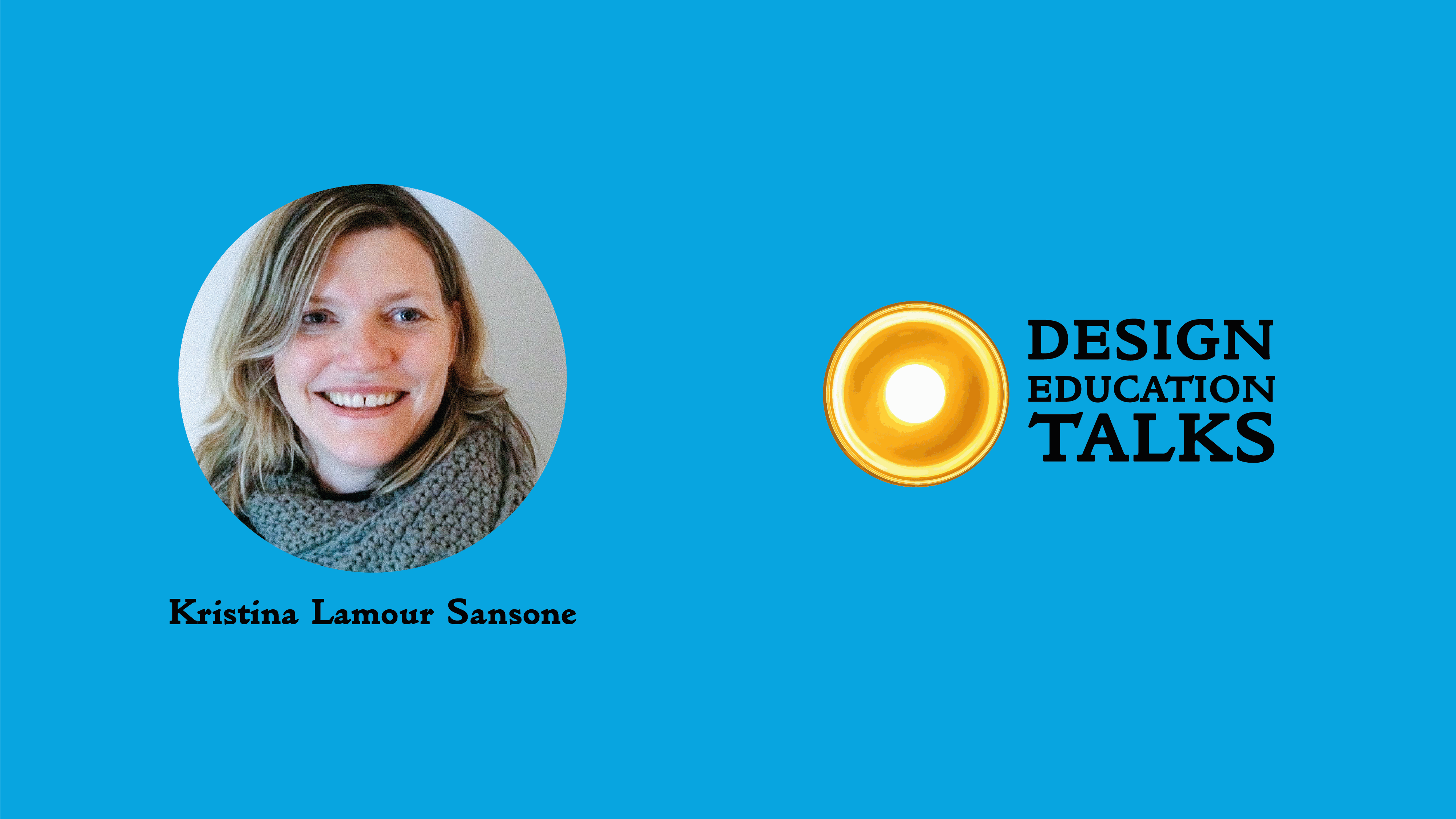
In conversation with Kristina Lamour Sansone, educator, critic, consultant, and founder of the platform Design Instinct Learning™, this tension between order and instinct reveals itself as more than a question of pedagogy. It is, in fact, a question of values, of representation, and of how design education must evolve in order to remain relevant to today’s diverse and urgent cultural context.
From the Ruling Pen to the Child’s Drawing
Kristina’s own journey began at the University of the Arts in Philadelphia in the late 1980s, immersed in the discipline of the international style. Her days were filled with six-hour studios, ruling pens, Plaka paint, and the slow, meticulous training of the eye. She remembers painting a sans serif E in black and white, a moment that crystallised the precision of her training, but also sharpened her questions.
“Where is the individual in this?” she asked.
Her senior thesis posed a radical question for its time: can graphic design be spontaneous?
Her mentor, Kenneth Hiebert, founder of the Philadelphia programme and himself a student of Basel, redirected her inquiry towards children’s drawings. In these instinctive, developmental marks Kristina discovered a bridge between graphic design and human growth, between the ordered world of typographic systems and the raw, spontaneous expression of a child making meaning for the first time.
That encounter marked the beginning of a lifelong inquiry that became Design Instinct Learning™, an umbrella framework for her teaching, consulting, and community organising.
Listening as Pedagogy
Kristina’s central conviction is disarmingly simple: education begins with listening.
Too often, she argues, design education treats students as blank slates. The foundation year becomes a reprogramming exercise: whatever you brought with you, your culture, your instincts, your values, is erased in favour of a sanctioned canon of “good design”.
“I’ve always had a problem with the blank slate mentality,” she says. “Students arrive with lives, with stories, with notions of beauty and usefulness. We must listen to that before we impose our own systems.”
This idea echoes Paulo Freire’s insistence that education is never neutral. In Pedagogy of the Oppressed, Freire argues that teaching which ignores the lived experience of students merely reproduces domination. bell hooks, similarly, described the classroom as a space of possibility only when it attends to the voices and identities students carry with them.
For Kristina, this is not about “expression” in a superficial sense, but about cultivating what she calls the hardwired instincts of designers, the deep, embodied ways humans make meaning. To do so requires faculty to “deeply listen” to the cultural identities and tendencies of students, rather than imposing a single standard.
The Spiritual Dimension of Design
When Kristina and her peers reflected on Kenneth Hiebert’s teaching, they often described it as a “spiritual quest”. Not in the sense of religion or mysticism, but as a recognition that design is not just problem-solving, it is value-making.
The notion that design has a spiritual or moral dimension is not new. William Morris tied design to social justice and labour reform. Ken Garland’s 1964 First Things First manifesto challenged designers to prioritise social good over commercial trivialities. More recently, figures such as Victor Papanek (Design for the Real World) have argued for a socially and environmentally responsible practice.
Yet design schools, particularly in North America, often struggle to acknowledge this. The language of values sits uneasily beside the rhetoric of industry readiness, market relevance, and technical proficiency. To frame design as a spiritual or value-driven practice risks being labelled esoteric, impractical, or “new age”.
And yet, Kristina insists, “the work is shaped by our values, not by visuals.”
Structural Challenges: Accreditation, Admissions, and Representation
The difficulty is not simply philosophical. As Kristina knows from her time in administration as Associate Dean, the challenges are structural.
Admissions processes frequently exclude diverse applicants. Hiring practices reproduce existing hierarchies. Accreditation bodies enforce compliance rather than innovation. Curricula remain tethered to a narrow canon.
Kristina cites the work of Dr. Cheryl D. Miller, whom I interviewed here for a Design Education Talk Special, whose searing critiques of racial exclusion in design education have helped reveal just how Eurocentric the field remains. A data visualisation commissioned for Print magazine showed the overwhelming whiteness of Philip Meggs’ History of Graphic Design, the standard text for decades. The absence of Black, Indigenous, Asian, and Latinx designers from the canon is not incidental; it is systemic erasure.
Decolonising the curriculum, then, is not an optional add-on. It is central to the credibility of design education in the twenty-first century.
New Schools for Rhode Island Inspired by Community
Confronting entrenched educational structures, Kristina has turned her energy toward community organizing in Rhode Island through Reciprocity Rhode Island (RRI), a cross-sector collective of leaders dedicated to working with students ages 14–24.
She co-founded RRI in 2021 with respected educational leader Zawadi Hawkins, with whom she had first collaborated in 2014 when Zawadi was Principal of Dr. Jorge Alvarez High School, a Providence public school. At that time, Kristina’s studio, Design Instinct Learning LLC, partnered with teachers to integrate project-based learning into the classroom.
It was at Alvarez that Kristina met Roberto Gonzalez, a core partner in the RRI Collective. Through his program, STEAMBoxRI, Roberto reimagines the traditional classroom as a makers’ design studio—placing students at the center of learning, even at the boardroom table. Youth engage in science, technology, engineering, the arts, and math while reimagining the future of Rhode Island’s urban core cities—or traveling to places such as Las Vegas and Japan as part of their educational journey.
Kristina’s longtime friend, Rupa Datta, an environmental and dance education leader in Rhode Island, introduced her to master printer and typographer Jacques Bidon. Kristina and Rupa’s sons had both attended Learning Brooke, a Reggio Emilia–inspired preschool. Jacques’s practice in Humanities education encourages students and teachers of all ages and stages to discover, design, and print their own voice. Today, his Bidon Community Print & Design Studio—widely respected and based in Providence—serves as the hub of RRI and as a prototype for community-inspired schools.
Roberto and Jacques’ leadership in community studio-based practice exemplifies Design Instinct Learning and the types of learning structures to inspire new schools in Rhode Island, drawing inspiration from the communities they serve.
Beyond Skills: Towards Values
One of the most pressing issues Kristina identifies is the tendency of higher education to collapse design into technical skill. Students arrive with varying degrees of craft ability, some highly skilled, others less so, but the conversation often stalls at technique.
For Kristina, the deeper question is: what values are those skills built upon?
If students learn typography but never question whose language or culture is being represented, what has truly been learned? If they master the grid but never interrogate why certain structures dominate, what instincts have been cultivated?
In this sense, her work resonates with John Ruskin’s insistence that art and design education must cultivate moral vision as much as craft, and with Paulo Freire’s call for a critical consciousness that challenges injustice.
The Case for Listening
What, then, is Kristina’s advice to educators? It is disarmingly simple: listen to students.
Listen not only to their words in the classroom, but to their histories, their struggles, their stories of migration, their visions of beauty and usefulness. Listen to their frustrations with existing structures. Listen to their hunger for representation.
This listening is not passive. It demands courage from faculty to challenge institutional cultures, to push against canons, to make their own values explicit. It requires acknowledging that students today, often more diverse, more politically conscious, more technologically fluent, carry wisdom that educators must learn from rather than dismiss.
“My son is only fourteen,” Kristina reflects, “but he is already wiser than me.”
Towards a New Architecture of Design Education
If design education is to remain relevant, it must move beyond its fixation on form and skill towards a new architecture built on values, representation, and instinct.
This means:
- Revising the canon to include erased and marginalised voices.
- Transforming admissions and hiring to ensure real diversity.
- Listening to communities and building schools from the ground up.
- Cultivating values as the foundation of design practice.
- Balancing structure with spontaneity, rule with instinct.
At its heart, Kristina LamourSansone’s vision is both radical and deeply human. It reminds us that design is not simply a career or a craft. It is a lifelong process of meaning-making, one that begins with the instinctual marks of a child and extends into the values we bring to shape the world.
And it begins, always, with listening.
Listen to the full podcast here!
👉 Follow Kristina on LinkedIn or explore her work at designeducator.com
If you’re vibing with what we do at The New Art School & Design Education Talks podcast 🎙️ and it’s helped or inspired you, consider supporting the project 💛 Even small donations go a long way → https://www.buzzsprout.com/1969986/support
Let’s keep design education alive & thriving! 🙌 #DesignEducation #SupportCreators
Where to Find More
Since its inception in 2019, Design Education Talks podcast has served as a dynamic platform for the exchange of insights and ideas within the realm of art and design education. This initiative sprang from a culmination of nearly a decade of extensive research conducted by Lefteris Heretakis. His rich background, intertwining academia, industry, and student engagement, laid the foundation for a podcast that goes beyond the conventional boundaries of educational discourse. Support the Show 👉https://www.patreon.com/thenewartschool Equipment used to produce the podcast: 👉https://kit.co/heretakis/podcasting See our work on 👉https://linktr.ee/thenewartschool Follow us on twitter at 👉@newartschool Read our latest articles at 👉https://heretakis.wordpress.com/ and 👉https://heretakis.medium.com/ and 👉 https://odysee.com/@thenewartschool:c

 The New Art School