

In the prevailing climate of flux and fragmentation, where institutions chase novelty as though it were meaning, the New Art School quietly but powerfully asserts an alternative path. It does not propose a rupture with the past, nor does it naively restore a romanticised tradition. Rather, it seeks to relink, a deliberate reconnection with the deep roots of design education in order to regenerate its purpose for the future.
At the centre of its vision lies a paradoxically simple truth: before we leap forward, we must look back, critically, humbly, imaginatively. We must return, not to repeat, but to recover what was lost, ignored, or dismissed along the way.
In doing so, the New Art School embodies a spirit strikingly consonant with that of John Ruskin, the great Victorian polymath, critic, artist, and educational reformer, whose own critique of industrial modernity and utilitarian education resonates today with startling urgency.
Relinking, Not Replacing
The first and most radical gesture of the New Art School is its refusal to sever the chain of cultural and educational succession. The manifesto states:
“The aim is not to sever the chain of succession but to relink it. To reimagine the future, we must first remember what we have forgotten.”
In other words, this is not a project of innovation for its own sake, but a recovery of continuity, of lineage, of situated wisdom. The New Art School looks back not in nostalgia, but with critical clarity. It asks: where have we gone wrong in our thinking about design education? What assumptions, absorbed from modernity, consumerism, and institutional inertia, must we unlearn?
In Ruskin on Education, William Jolly describes Ruskin as a prophet who condemned the “narrowing and intolerant pursuit of less worthy aims in this mammon-loving, competitive time,” and who saw the education of the young as one of the great battlegrounds for the moral future of society. Ruskin’s writings on education, often overlooked in favour of his works on art and architecture, offer a stirring vision of pedagogy as moral, aesthetic, and spiritual cultivation, not simply preparation for economic advancement.
The New Art School manifesto might be read as a Ruskinian echo, a contemporary reiteration of these values in the face of rampant vocationalism and institutional fatigue.
Against the Culture of Severance
Modern design education, particularly in the Anglophone world, often suffers from what could be termed a culture of severance. Courses are modularised. Histories are dislocated. Practices are split into silos, branding from typography, strategy from image-making, research from form. And perhaps most damaging of all, the student is cut off from their own creative intuition through the excessive mediation of assessment, metrics, and deliverables.
The New Art School positions itself as a counter-site, a place of re-integration. It encourages an approach where thinking, making, writing, and reflecting are not separated but interwoven. Where conversation is as valid as critique. Where ambiguity and slowness are allowed to coexist with skill and rigour.
This is entirely in keeping with Ruskin’s educational vision. Ruskin opposed the dominant 19th-century ideal of education as training for “success in life,” which he saw as a hollow phrase. “The more I see of our national faults or miseries,” he wrote, “the more they resolve themselves into conditions of childish illiterateness and want of education in the most ordinary habits of thought.”
For Ruskin, education was not about climbing ladders or winning prizes, but about the formation of the whole person, the moral, intellectual, and sensory faculties working in harmony. The New Art School shares this aim: to cultivate designers who are not merely competent, but conscious.
The Designer as Thinker, Maker, and Steward
One of the most vital contributions of the New Art School is its insistence that designers must be more than service providers or visual stylists. They are cultural agents. Interpreters of complexity. Stewards of visual language. Their role is not merely to “solve problems” but to ask better questions, to shape the ethical and aesthetic dimensions of the world we live in.
Ruskin, too, saw the artist and designer as a steward, not of commerce, but of truth and beauty. He believed that design, like all forms of work, must be guided by a sense of reverence, toward materials, communities, nature, and the divine. In his Stones of Venice, he famously advocated for imperfection in ornament, because it preserved the human touch, the evidence of the maker’s presence.
The New Art School continues this lineage by elevating process over product, and ethos over effect. It encourages students to question their tools, reframe their briefs, and invent their own methodologies, not as a gesture of performative individuality, but as an act of care.
A Pedagogy of Slowness
Slowness is a radical act. In a world driven by speed, acceleration, and constant digital feedback, to move slowly is to reclaim time for depth, attention, and reflection.
The New Art School invites students into a different tempo. One in which drawing can be a meditative act. Where conversations take precedence over presentations. Where outcomes are not fixed, but emerge. In this sense, it proposes what might be called a pedagogy of presence.
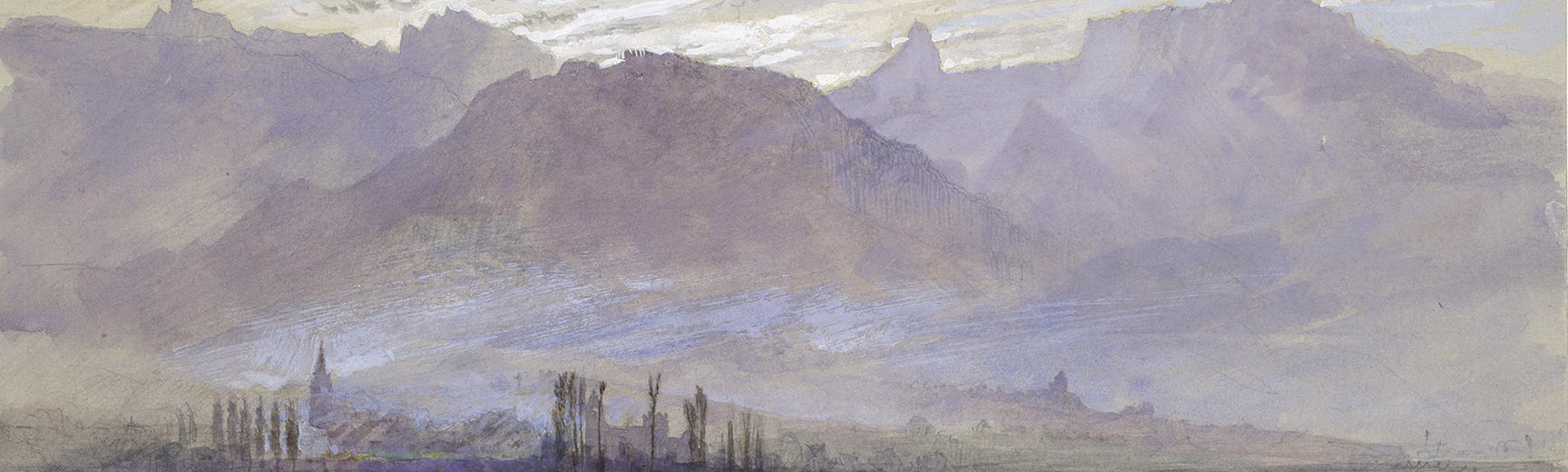
This was central to Ruskin’s idea of the out-of-doors classroom. In Sesame and Lilies, he described how the “outdoor classroom” of nature, the forests, the fields, the mountains, was more instructive than any conventional schoolroom. Education, for him, had to engage the senses and awaken the moral imagination. The New Art School echoes this in its call for experiential, embodied learning that is attuned to place, gesture, and materiality.
Recovering Lost Tools
One of the most poignant passages in the New Art School manifesto reads:
“The New Art School looks for what was thrown away too hastily, and what may now be recovered.”
This is not merely about aesthetic recovery, though it includes that. It is about the restoration of cultural tools and intellectual virtues that have been devalued: patience, drawing, dialogue, doubt, ornament, symbolism, silence, slowness.
Ruskin’s own ideal curriculum, described in Jolly’s text, emphasised drawing from nature, understanding materials, reading great literature, and cultivating taste, not in the bourgeois sense, but in the profound sense of being able to discern and delight in what is good.
In this, the New Art School is neither traditionalist nor technophobic. It does not reject digital tools. But it insists that digital fluency must be accompanied by critical clarity and aesthetic discernment. It is entirely possible to be proficient in Figma and still be visually illiterate. The aim is not to be faster, but to be freer and deeper.
From Competition to Contribution
Finally, both the New Art School and Ruskin call for the end of education as competition, and its restoration as contribution.
Ruskin fiercely criticised the competitive examination system of his time, believing it encouraged vanity, conformity, and anxiety rather than real learning. He proposed instead “schools of trial,” where students could discover their strengths through useful work and generous collaboration.
The New Art School proposes a similar ethic: one in which students contribute to a shared studio culture, one that prizes questions over rankings, and solidarity over self-promotion. In such an environment, criticism becomes dialogue, not judgment. Projects are not pitched, but situated, in the world, in history, in real consequence.
Conclusion: A New Beginning Rooted in Memory
To teach design today is to stand at a crossroads. We can continue down the path of instrumentalisation and market-driven metrics. Or we can turn, gently, deliberately, toward a different horizon. One where art schools become sanctuaries for reflection, imagination and action. Where design returns to its roots as a civic, poetic and above all ethical practice.
The New Art School offers us a compass, not a curriculum. It asks us to slow down, dig deeper, and relink the broken chain of education, not to reimpose the past, but to reawaken its latent wisdom.
John Ruskin wrote that “the highest reward for a person’s toil is not what they get for it, but what they become by it.” In that spirit, the New Art School is less concerned with what students make, and more with who they become, as designers, citizens, and human beings.
That, surely, is a future worth designing.
#designpedagogy #johnruskin #newartschool #graphicdesign #designeducation #aesthetics #craft #studioethics #slowdesign #artschool #designthinking #futureofeducation #criticalpedagogy #purposefuldesign
If you’re vibing with what we do at The New Art School & Design Education Talks podcast 🎙️ and it’s helped or inspired you, consider supporting the project 💛 Even small donations go a long way → https://www.buzzsprout.com/1969986/support
Let’s keep design education alive & thriving! 🙌 #DesignEducation #SupportCreators
Where to Find More
Since its inception in 2019, Design Education Talks podcast has served as a dynamic platform for the exchange of insights and ideas within the realm of art and design education. This initiative sprang from a culmination of nearly a decade of extensive research conducted by Lefteris Heretakis. His rich background, intertwining academia, industry, and student engagement, laid the foundation for a podcast that goes beyond the conventional boundaries of educational discourse. Support the Show 👉https://www.patreon.com/thenewartschool Equipment used to produce the podcast: 👉https://kit.co/heretakis/podcasting See our work on 👉https://linktr.ee/thenewartschool Follow us on twitter at 👉@newartschool Read our latest articles at 👉https://heretakis.wordpress.com/ and 👉https://heretakis.medium.com/ and 👉 https://odysee.com/@thenewartschool:c

 The New Art School