

By Lefteris Heretakis RCA Designer | Educator | podcaster
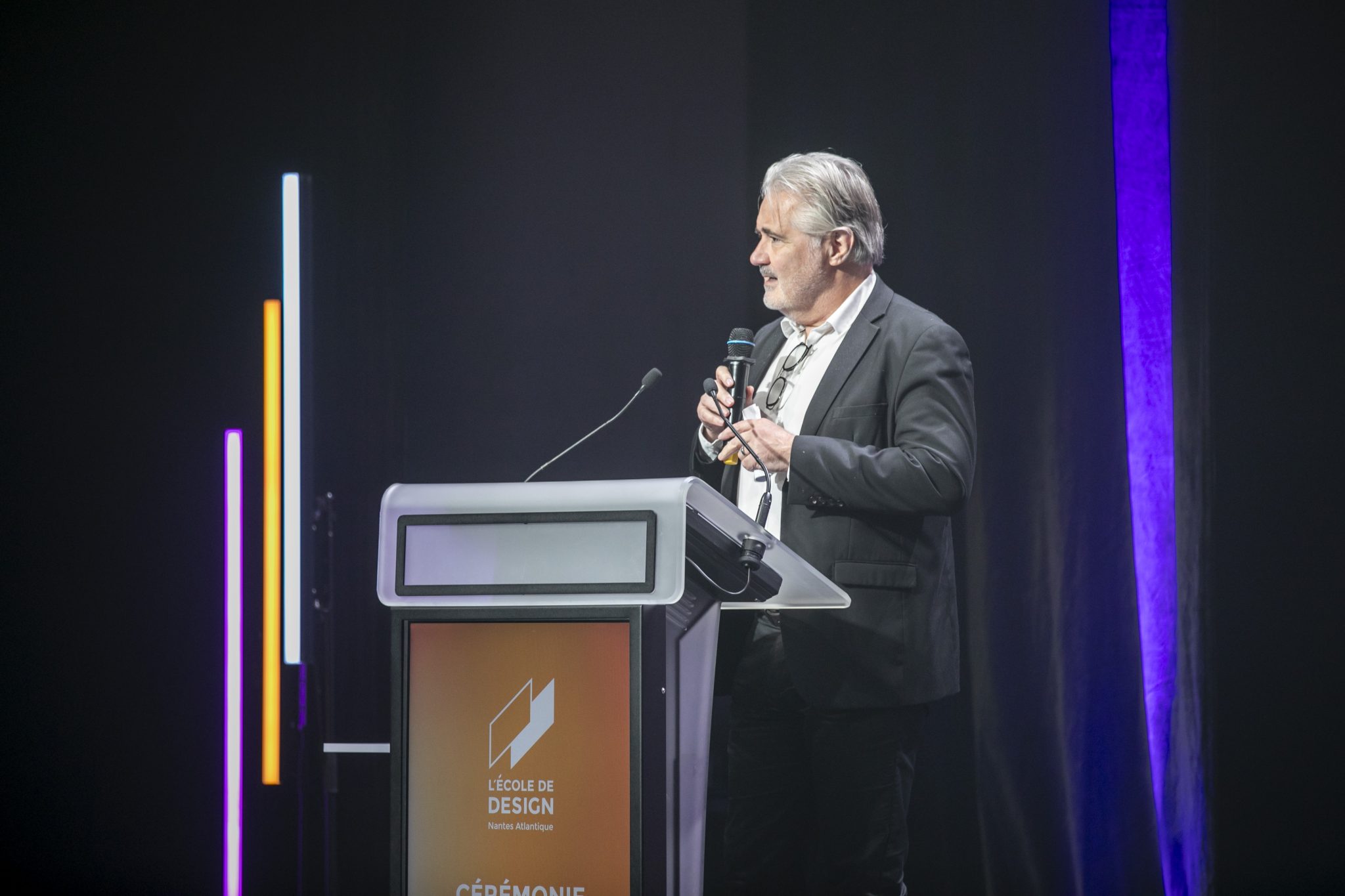
We had the pleasure of speaking with Christian Guellerin—Executive Director of L’École de Design Nantes Atlantique and Honorary President of Cumulus, the world’s largest network of art, design, and media universities.
Christian is a rare voice in the design education space—a business-trained leader who champions design not just as a creative practice, but as a strategic tool for shaping the future. Our conversation ranged from the role of design in global innovation to the urgent ethical questions posed by AI and the climate crisis. It was a profound reminder of why design education must evolve—and fast.
From Business to Design
“I’m not a designer,” Christian admits early on, “but I discovered that a design school is the very kind of management school I wish I’d attended.”
Two decades ago, Christian took over an applied arts school in Nantes. Under his leadership, it transformed into a design institution rooted in strategic thinking, real-world collaboration, and global expansion. Today, L’École de Design Nantes Atlantique has 1,500 students and satellite campuses in China, India, Brazil, Canada, and West Africa. This expansion reflects a broader ambition: to position design education as a response to global challenges.
Design as Strategy, Not Styling
Christian speaks passionately about the need to redefine design as a strategic discipline, not a decorative one. “There has been a shift,” he explains. “We used to focus on doing better what we already knew how to do. Now, we must imagine what we’ve never done before.”
This shift—from efficiency to innovation—makes design a powerful driver of transformation. But it also demands a new kind of designer: one who understands management, business, technology, philosophy, and social sciences. “Designers must be able to bring people together—engineers, marketers, financiers, philosophers—and help them build a shared vision of the future.”
Professionalisation and Purpose
One of the most striking points in our conversation was Christian’s emphasis on professionalisation. He believes the ultimate goal of design education should be employment—not just in creative roles, but in strategic leadership positions.
“We prepare designers for their first job at 25, but what about their role at 35, 45?” he asks. “If we claim that design is strategic, we must prepare our students to take strategic roles.”
Why aren’t there designers in Parliament? Why aren’t designers becoming CEOs or public policymakers? According to Christian, it’s because we still don’t equip them to think of themselves that way.
Designing for the Big Questions
Our conversation turned toward the existential challenges we face: climate change, artificial intelligence, and what it means to be human in an age of machines.
“We used to talk about protecting the planet,” Christian says. “Now we must talk about saving it.” And in that urgent mission, design has a crucial role to play—not just to visualise better futures, but to give those futures meaning.
He recounts a provocative TEDx talk he gave: “What does it mean to be human if robots are more intelligent than we are?” As AI begins to mimic emotion, understand nuance, and respond to empathy, the boundary between human and machine is blurring. Designers, he argues, are uniquely placed to ask and shape the answers to those questions.
Global Identity and the Role of the Designer
One of Christian’s most powerful insights relates to identity in an interconnected world. “We must never become global designers,” he says. “We must remain French designers, Chinese designers, Brazilian designers—designers who operate globally, but never forget where they come from.”
This call to protect and celebrate cultural specificity is crucial in a time when globalisation risks flattening identity. True design innovation, he believes, comes from enriching one’s culture by engaging with others, not by erasing difference.
Entrepreneurship and Real-World Impact
Christian also emphasises the need for designers to become entrepreneurs of their own ideas. Too often, students graduate with impressive concepts that never see the light of day. The final project remains a beautifully rendered bicycle on a screen—never manufactured, never tested, never lived.
To counter this, the school has launched partnerships with startup incubators—particularly in Montreal—where students are embedded in early-stage companies and expected to contribute strategically. “In a team of four, the student isn’t just an intern—they become a decision-maker.”
A Call to Optimism
Despite the challenges, Christian remains fiercely optimistic. “There is no room for pessimism,” he declares. “I believe designers are clever enough to draw a brilliant world for tomorrow.”
That belief is what continues to drive his work: preparing the next generation of designers to shape not just the objects and services we use—but the values and visions that define our shared future.
👋 Let’s Stay Connected
Listen to the full episode here: https://www.buzzsprout.com/1969986/episodes/10431509
You can follow Christian Guellerin on LinkedIn or find more about L’École de design Nantes Atlantique on their official website.
For more conversations like this, follow Design Education Talks wherever you get your podcasts—and subscribe to The New Art School for more articles on the future of design and education.

 The New Art School