

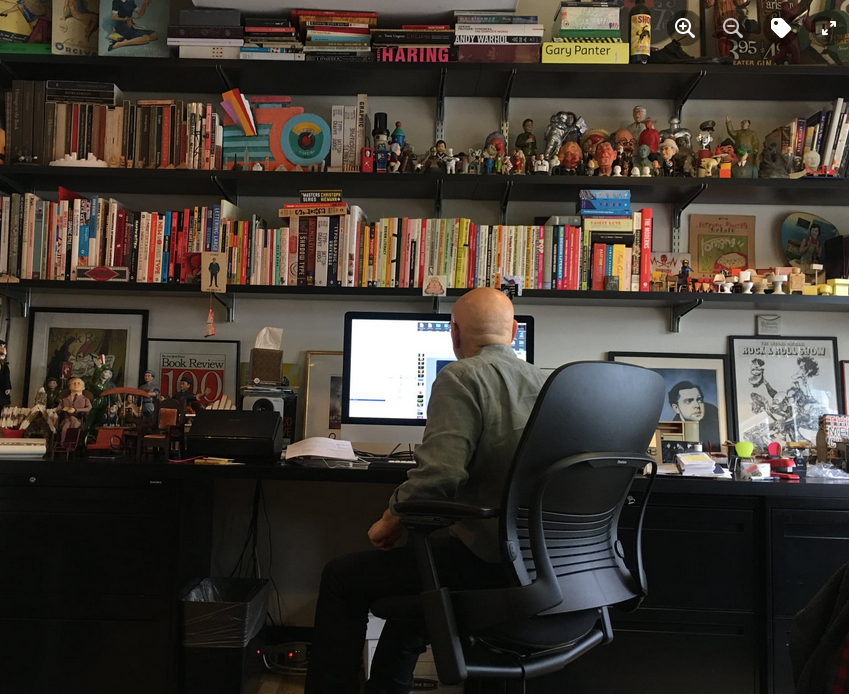
In the ever-evolving world of graphic design, few names resonate as deeply and expansively as Steven Heller. With a career that bridges journalism, education, authorship, and design history, Heller stands as one of the most prolific and influential figures in the field. His impact spans generations, disciplines, and continents, shaping not only how we see design, but how we think about it.
“I’ve always been an inquisitive character,” Heller told me. “I’ve always loved history, teaching it, writing it, learning it. The niche I found to situate my passions is design, and more specifically graphic design, and how it operates in the world.” That inquisitiveness has carried him through more than five decades of shaping design culture.
From Underground to The New York Times
Heller’s path into design was anything but conventional. As a student at New York University during the Vietnam War, he stumbled into the underground press, working for the New York Free Press and later contributing a comic strip to the infamous sex-and-politics paper Screw. His satire got him expelled from NYU, but led him to the School of Visual Arts, first as a student, then, unexpectedly, as a teacher.
That unorthodox beginning blossomed into a storied career. For over three decades, Heller served as art director at The New York Times, most notably guiding the visual direction of the New York Times Book Review. He also briefly oversaw the Op-Ed page and earned a reputation as the paper’s unofficial chronicler of the design world. “I wrote obituaries for maybe 63 designers,” he recalled. “I was called the angel of death because I’d always get a call when someone was very ill or had passed away. I had to jump to the occasion and write a news story.”
Beyond obituaries, he wrote columns such as Visuals for the Book Review and Graphic Content for T Magazine, as well as Campaign Stops, which analyzed the graphic language of Obama-era politics. His editorial voice became an anchor in the public discourse of visual communication.
Education and the Designer as Entrepreneur
Yet Heller’s most enduring legacy may lie in education. Alongside Lita Talarico, he co-founded the MFA Design: Designer as Entrepreneur program at the School of Visual Arts in New York City. For 27 years, the program has redefined the designer’s role, encouraging students to move beyond the client-brief paradigm and pursue self-initiated, socially engaged, and commercially viable projects.
This year, Heller and Talarico stepped down as co-chairs, closing a remarkable chapter. Reflecting on the decades of teaching, Heller noted how demographics transformed his classrooms: “In the past decade, the foreign population has outnumbered the American population, and they’ve brought a considerable amount of intelligence and talent. Design hasn’t changed so much stylistically, but conceptually. The contribution of people from India, Turkey, China, Taiwan, Korea, Cambodia, and Thailand has been extremely productive.”
He is candid about his teaching philosophy: “I never thought of myself as a teacher because I don’t have any specific skill to teach. What I do is provide research skills, context, and opportunities for students to explore. Everything requires presentation. Everything requires narrative.”
His courses, like No Google, which forced students to research design objects without the internet, and the forthcoming No AI, reflect his insistence on rigor, resourcefulness, and critical thinking. “Learning is a branching tree,” he says. “It’s just as interesting to find out who made something as to what was made.”
Author, Historian, Prolific Maker
Equally staggering is Heller’s output as a writer. He has authored, co-authored, or edited more than 200 books spanning graphic design, typography, satirical illustration, propaganda, and visual culture. Some are sweeping histories of movements and manifestos; others are affectionate studies of vernacular graphics, matchbooks, or comic books.
What is striking is how seamlessly his writing and teaching intersect. “I often teach what I’m working on as a book or article because information is free-floating, it can attach itself to any platform,” he said. “Teaching gives me a way to test theories, to see how students respond to them.”
Collaboration has been central to this body of work. His partnerships with Gail Anderson, Veronique Vienne, Mirko Ilić, and especially Lita Talarico have produced a wealth of books. With his wife, acclaimed designer Louise Fili, he shares a deeply entwined professional life, having written two monographs on her work. And with Seymour Chwast, he has co-authored more than a dozen books, most recently HELL: The People, The Places, a playful yet critical tour through cultural symbolism.
The Daily Heller and a Life in Reflection
Even today, Heller writes with remarkable consistency. His long-running column, The Daily Heller on Printmag.com, offers insights, reflections, and discoveries in design with wit and accessibility. It remains a daily ritual for countless designers who look to him not only for knowledge but for perspective.
In 2022, he published Growing Up Underground: A Memoir of Counterculture New York, tracing his formative years in the creative underground of the 1960s and ’70s. The book is both candid and richly illustrated, capturing the collision of politics, publishing, and art that shaped his lifelong engagement with design.
Design Philosophy and the Challenges Ahead
For Heller, design has always been about more than aesthetics. “Design is not just about making things look good, it’s about making sense of the world,” he insists. This worldview underpins his new experimental courses on propaganda and branding democracy, where he asks students to wrestle with how visual communication influences, persuades, and sometimes manipulates.
He is sceptical yet curious about AI. “With ChatGPT, everyone who has to write can start with a structure. But I think you have to find your own structure. Photoshop doesn’t have an opinion, ChatGPT seems to. But so do teachers, so do masters. GPT scrapes the masters.” For him, the challenge is to help students balance employability with authenticity, rigor with experimentation.
His advice to students remains simple: “Keep doing what you’re doing. Keep learning. Accept criticism, but learn to distinguish what is valuable and what is extraneous. And keep thinking.”
Recognition and Legacy
Recognition of Heller’s contributions has come in abundance: the AIGA Medal, membership in the Art Directors Hall of Fame and the One Club Educators Hall of Fame, the Smithsonian National Design Award for Design Mind, and honorary doctorates from institutions in Detroit and the Czech Republic.
Yet perhaps his most significant achievement is less tangible: the generations of students, colleagues, and readers who now think more critically, historically, and humanistically about design because of him.
As our conversation closed, Heller reflected with humility: “This is the last hurrah for me and my co-chair in this context. I’m going to teach a little more. But new blood is always necessary.”
Closing
Steven Heller embodies the idea that design is not merely a profession, but a cultural and intellectual force. He is a connector, of ideas, people, history, and practice, and his work continues to inspire educators, students, and professionals alike to explore, question, and create.
At Design Education Talks, we celebrate Steven Heller and those who dedicate their lives to pushing design forward, making knowledge accessible, and reminding us that design is, at its core, a cultural and humanistic endeavour.
watch the full conversation here
listen to the podcast here
References & Further Reading
- Heller, Steven. Growing Up Underground: A Memoir of Counterculture New York. Princeton Architectural Press, 2022.
- Heller, Steven & Louise Fili. Stylepedia: A Guide to Graphic Design Mannerisms, Quirks, and Conceits. Chronicle Books, 2006.
- Heller, Steven & Seymour Chwast. Graphic Style: From Victorian to Digital. Harry N. Abrams, 2017 (updated edition).
- Heller, Steven & Lita Talarico. The Design Entrepreneur: Turning Graphic Design Into Goods That Sell. Rockport, 2008.
- Heller, Steven & Véronique Vienne. 100 Ideas That Changed Graphic Design. Laurence King, 2012.
- Heller, Steven & Gail Anderson. The Typography Idea Book: Inspiration from 50 Masters. Laurence King, 2016.
- Heller, Steven (ongoing). The Daily Heller on Printmag.com link
Where to Find More
Since its inception in 2019, Design Education Talks podcast has served as a dynamic platform for the exchange of insights and ideas within the realm of art and design education. This initiative sprang from a culmination of nearly a decade of extensive research conducted by Lefteris Heretakis. His rich background, intertwining academia, industry, and student engagement, laid the foundation for a podcast that goes beyond the conventional boundaries of educational discourse. Support the Show 👉https://www.patreon.com/thenewartschool Equipment used to produce the podcast: 👉https://kit.co/heretakis/podcasting See our work on 👉https://linktr.ee/thenewartschool Follow us on twitter at 👉@newartschool Read our latest articles at 👉https://heretakis.wordpress.com/ and 👉https://heretakis.medium.com/
Audio:
https://www.buzzsprout.com/1969986/episodes/14934311
Video
https://odysee.com/@thenewartschool:c/design-education-talks-ep.-85-steven:1
If this resonated, share it with someone who still believes imagination matters. Or better yet, create. Not for the market. But for the world.
If you’re vibing with what we do at The New Art School & Design Education Talks podcast 🎙️ and it’s helped or inspired you, consider supporting the project 💛 Even small donations go a long way → https://www.buzzsprout.com/1969986/support
Let’s keep design education alive & thriving! 🙌 #DesignEducation #SupportCreators
Where to Find More
Since its inception in 2019, Design Education Talks podcast has served as a dynamic platform for the exchange of insights and ideas within the realm of art and design education. This initiative sprang from a culmination of nearly a decade of extensive research conducted by Lefteris Heretakis. His rich background, intertwining academia, industry, and student engagement, laid the foundation for a podcast that goes beyond the conventional boundaries of educational discourse. Support the Show 👉https://www.patreon.com/thenewartschool Equipment used to produce the podcast: 👉https://kit.co/heretakis/podcasting See our work on 👉https://linktr.ee/thenewartschool Follow us on twitter at 👉@newartschool Read our latest articles at 👉https://heretakis.wordpress.com/ and 👉https://heretakis.medium.com/ and 👉 https://odysee.com/@thenewartschool:c

 The New Art School